Monday, March 25, 2013

Monday, March 4, 2013
Workshop IV at NED Karachi 2013
At NED
Karachi
10th
– 18th February, 2013
Workshop:
Taj Mahal - In Search of the Essence
of its Beauty.
(Geometrical
Proportioning in Mughal Architecture)
Conducted
by Taimoor Khan Mumtaz
Highlights
Theoretical Frame-work for
the understanding of Islamic Art & Architecture.
Practical exposure to the
use of Geometry in design.
Methods & Vocabulary
of design used in Mughal Architecture.
Geometric Analysis of
Mughal Architecture.

 |
| Concluding Exhibition |


Thursday, January 10, 2013
Article in Express Tribune

LAHORE:Iqbal Salahuddin has a
passion for Islamic architecture in Spain, Morocco, Turkey, Iran and the
Subcontinent. So when building a mosque in memory of his father, he decided to
borrow from them.
“I
wanted to incorporate similar colour themes here,” he says, pointing to the
hues of blue in the under-construction mosque at a one-kanal site in Salli
Town, which is named after his father Mian Salahuddin, the son-in-law of Allama
Iqbal.
“The
light sky blue signifies the mercy of God and it is used heavily in early
Islamic scripture,” says Salahuddin. Dark blue, the colour of the tiles used
for the lower half of the verandah walls, signifies mysticism in Islam, he
says. A golden and black arch (mehrab) signalling the direction of the Kaaba is
inspired by the tomb of Bayazid Bastami in Iran.
There
are inspirations from closer to home too. The floral frescoes are modelled on
Masjid Wazir Khan and Masjid Bibi Khanum. Architect Kamil Khan Mumtaz, an
authority on Mughal architecture, designed the building.
Wednesday, December 26, 2012
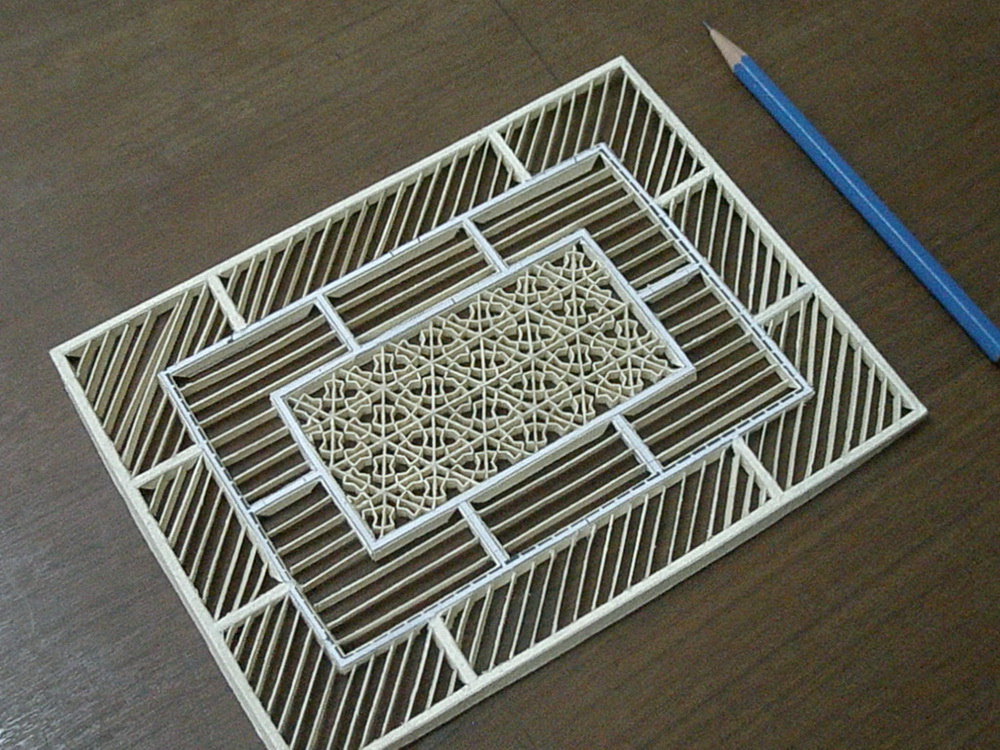
Metal Grill Study-Model
Study-Model by
Architect Hassan Bin Tariq (2009 NCA)
for developing a louvered metal-grill for a
South-West facing (38 deg) window
for a KKM project in Lahore.

Tuesday, December 4, 2012

Tuesday, October 23, 2012
Workshop III at NED, February 2012
 |
| Site-Visit to A Contemporary Project: Mazar of Hazrat Tanbih Ahmed in Sakhi Graveyard, Karachi. |
 |
| Site Visist to Shahi Mosque at Thatta |
Islamic Architecture Workshop at NED, 2012
A 10-day workshop conducted
by Taimoor Khan Mumtaz, was organized by the History Group of the Department of Architecture and Planning NEDUET from 6th till 16th February, 2012. This was the third in the HG Workshop series.
This year’s workshop was special on many counts. In
the previous two years the workshops had been mainly focused on learning the
vocabulary and drawing methods of elements of Islamic Architecture, ending in
fabrication of life-sized elements, but in non-architectural materials –
card-board and polystyrene respectively. But this year the focus of the
workshop was equally divided into the elements or vocabulary on the one hand and
the process and materials of construction on the other.
The premise for this year’s workshop was the observation
that in traditional architecture one sees a balance of two key qualities. One
set of qualities derives from the art of architecture itself i.e. from sound
building practice and building construction solutions according to the material
of construction used. The other set of qualities derives from the consistent
application of a coherent aesthetic system which aims to achieve harmony and beauty
in the spaces and surfaces it creates. This
last is in its turn based on the philosophy of Islamic art which was the third
main element of the workshop.
An example of the first set of qualities is the solution
to the problem of roofing a square room with bricks. This results not only in
domes but also in a variety of ways to solve the problem of transitioning from
the cube of the room to the sphere of the dome. Thus the participants saw in
their field visit to Makli and Thatta that the whole vocabulary of brick architecture
of this region results in part from purely building construction solutions.
One of the aims of the workshop was to focus on this
first set of qualities i.e. those resulting from the way a building is put
together. An appreciation of this aspect of architecture is sorely missing in architectural
education in Pakistan and is therefore reflected in the unconvincing and 'cardboard' architecture
we see so often around us.
The second aim of the workshop was to address the inexplicable
absence of the traditional architecture of Pakistan from architectural
education. Given the fact that Pakistan is heir to a traditional architecture
which is one of the summits of world architecture, the workshop aimed at
studying and learning from this tradition.
The workshop was based on the argument that a
Pakistani architect should in all logic have some exposure to the basic
vocabulary and methods used in the traditional architecture of Pakistan. For it
can be argued that a self-confident, convincing and meaningful architecture (or
architectures) for Pakistan is only possible if it is rooted in such a knowledge.
Lastly we are also heirs to a long building-craft
tradition which again finds no place in our architectural education. Hence the
workshop included the active participation of Ustad Javed Chohan a hereditary
master-mason from Karachi and his team of masons.


Thursday, May 31, 2012

Subscribe to:
Comments (Atom)